Taxonomic group: bacteria / Proteobacteria
(Phylum: Proteobacteria)
Associated disease: infection due to Escherichia coli [ICD11:
XN6P4 
]
The structure was elucidated in this paperNCBI PubMed ID: 27274048Publication DOI: 10.1073/pnas.1518311113Journal NLM ID: 7505876Publisher: National Academy of Sciences
Correspondence: md255

cornell.edu
Institutions: Complex Carbohydrate Research Center, The University of Georgia, Athens, GA 30602, Department of Microbiology, University of Iowa, Iowa City, IA 52242, Department of Molecular Biosciences, The University of Texas at Austin, Austin, TX 78712, Department of Infectious Diseases, The University of Georgia College of Veterinary Medicine, Athens, GA 30602, Genetics Program, University of Iowa, Iowa City, IA 52242, Robert Frederick Smith School of Chemical and Biomolecular Engineering, Cornell University, Ithaca, NY 14853, Nancy E. and Peter C. Meinig School of Biomedical Engineering, Cornell University, Ithaca, NY 14853
The O-antigen polysaccharide (O-PS) component of lipopolysaccharides on the surface of gram-negative bacteria is both a virulence factor and a B-cell antigen. Antibodies elicited by O-PS often confer protection against infection; therefore, O-PS glycoconjugate vaccines have proven useful against a number of different pathogenic bacteria. However, conventional methods for natural extraction or chemical synthesis of O-PS are technically demanding, inefficient, and expensive. Here, we describe an alternative methodology for producing glycoconjugate vaccines whereby recombinant O-PS biosynthesis is coordinated with vesiculation in laboratory strains of Escherichia coli to yield glycosylated outer membrane vesicles (glycOMVs) decorated with pathogen-mimetic glycotopes. Using this approach, glycOMVs corresponding to eight different pathogenic bacteria were generated. For example, expression of a 17-kb O-PS gene cluster from the highly virulent Francisella tularensis subsp. tularensis (type A) strain Schu S4 in hypervesiculating E. coli cells yielded glycOMVs that displayed F. tularensis O-PS. Immunization of BALB/c mice with glycOMVs elicited significant titers of O-PS-specific serum IgG antibodies as well as vaginal and bronchoalveolar IgA antibodies. Importantly, glycOMVs significantly prolonged survival upon subsequent challenge with F. tularensis Schu S4 and provided complete protection against challenge with two different F. tularensis subsp. holarctica (type B) live vaccine strains, thereby demonstrating the vaccine potential of glycOMVs. Given the ease with which recombinant glycotopes can be expressed on OMVs, the strategy described here could be readily adapted for developing vaccines against many other bacterial pathogens.
glycan, glycoconjugate vaccine, O-antigen polysaccharide, anti-glycan antibodies, humoral immune response, outer membrane vesicle
Structure type: oligomer ; 849.2 [M+Na]+
Location inside paper: p.E3612, fig.3C, Ft-glycOMVs, table S1
Compound class: O-polysaccharide
Contained glycoepitopes: IEDB_135813,IEDB_137340,IEDB_141807,IEDB_151531
Methods: 13C NMR, 1H NMR, NMR-2D, sugar analysis, ELISA, Western blotting, MALDI-TOF MS, biological assays, NMR-1D, serological methods, genetic methods, electron microscopy, SEC, immunization
Biological activity: creation a new approach for the production of glycoconjugate vaccines by combining recombinant O-PS biosynthesis with outer membrane vesicle (OMV) formation in laboratory strains of E. coli
Comments, role: The F. tularensis OPS tetrasaccharide was isolated from LPS derived in E. coli strain JC8031 carrying plasmid pGAB2, and generated OMVs was termed “Ft-glycOMVs”; published erroneous NMR chemical shift of #_bDGlcpN C1 (103.8) was removed by CSDB staff
Related record ID(s): 11304, 11692
NCBI Taxonomy refs (TaxIDs): 562Reference(s) to other database(s): GTC:G49310VB
Show glycosyltransferases
NMR conditions: in D2O at 303 K
[as TSV]
13C NMR data:
Linkage	Residue	C1	C2	C3	C4	C5	C6
3,4,4,4	Fo
3,4,4	bDQuip4N	106.6	76.6	75.9	58.1	73.3	19.5
3,4,2	Ac
3,4,6	NH2
3,4	aDGalpNA	101.5	52.3	70.5	81.3	73.4	?
3,2	Ac
3,6	NH2
3	aDGalpNA	101.0	52.3	68.8	78.0	73.1	?
2	Ac
	bDGlcpN	?	57.1	82.8	67.4	78.5	63.1


1H NMR data:
Linkage	Residue	H1	H2	H3	H4	H5	H6
3,4,4,4	Fo
3,4,4	bDQuip4N	4.50	3.36	3.50	3.62	3.48	1.18
3,4,2	Ac
3,4,6	NH2
3,4	aDGalpNA	5.03	4.26	4.11	4.47	4.85	-
3,2	Ac
3,6	NH2
3	aDGalpNA	5.41	4.24	4.00	4.43	4.25	-
2	Ac
	bDGlcpN	4.57	3.75	3.72	3.63	3.43	3.74-3.90


1H/13C HSQC data:
Linkage	Residue	C1/H1	C2/H2	C3/H3	C4/H4	C5/H5	C6/H6
3,4,4,4	Fo
3,4,4	bDQuip4N	106.6/4.50	76.6/3.36	75.9/3.50	58.1/3.62	73.3/3.48	19.5/1.18
3,4,2	Ac
3,4,6	NH2
3,4	aDGalpNA	101.5/5.03	52.3/4.26	70.5/4.11	81.3/4.47	73.4/4.85
3,2	Ac
3,6	NH2
3	aDGalpNA	101.0/5.41	52.3/4.24	68.8/4.00	78.0/4.43	73.1/4.25
2	Ac
	bDGlcpN	?/4.57	57.1/3.75	82.8/3.72	67.4/3.63	78.5/3.43	63.1/3.74-3.90
1H NMR data:
| Linkage | Residue | H1 | H2 | H3 | H4 | H5 | H6 |
|---|
| 3,4,4,4 | Fo | |
| 3,4,4 | bDQuip4N | 4.50 | 3.36 | 3.50 | 3.62 | 3.48 | 1.18 |
| 3,4,2 | Ac | |
| 3,4,6 | NH2 | |
| 3,4 | aDGalpNA | 5.03 | 4.26 | 4.11 | 4.47 | 4.85 |
|
| 3,2 | Ac | |
| 3,6 | NH2 | |
| 3 | aDGalpNA | 5.41 | 4.24 | 4.00 | 4.43 | 4.25 |
|
| 2 | Ac | |
| | bDGlcpN | 4.57 | 3.75 | 3.72 | 3.63 | 3.43 | 3.74
3.90 |
|
13C NMR data:
| Linkage | Residue | C1 | C2 | C3 | C4 | C5 | C6 |
|---|
| 3,4,4,4 | Fo | |
| 3,4,4 | bDQuip4N | 106.6 | 76.6 | 75.9 | 58.1 | 73.3 | 19.5 |
| 3,4,2 | Ac | |
| 3,4,6 | NH2 | |
| 3,4 | aDGalpNA | 101.5 | 52.3 | 70.5 | 81.3 | 73.4 | ? |
| 3,2 | Ac | |
| 3,6 | NH2 | |
| 3 | aDGalpNA | 101.0 | 52.3 | 68.8 | 78.0 | 73.1 | ? |
| 2 | Ac | |
| | bDGlcpN | ? | 57.1 | 82.8 | 67.4 | 78.5 | 63.1 |
|
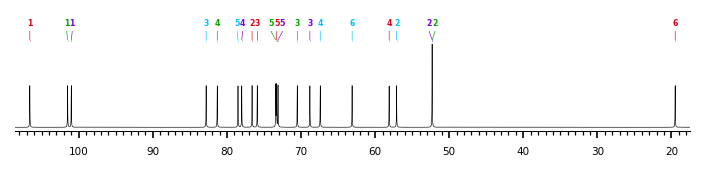
The spectrum also has 3 signals at unknown positions (not plotted). |
There is only one chemically distinct structure:
 report error
 Found 1 record.
Displayed record 1
Found 1 record.
Displayed record 1
