Taxonomic group: bacteria / Proteobacteria
(Phylum: Proteobacteria)
Associated disease: infection due to Escherichia coli [ICD11:
XN6P4 
]
The structure was elucidated in this paperNCBI PubMed ID: 19682076Publication DOI: 10.1111/j.1574-695X.2009.00584.xJournal NLM ID: 9315554Publisher: Elsevier
Correspondence: wagle

nankai.edu.cn
Institutions: N.D. Zelinsky Institute of Organic Chemistry, Russian Academy of Sciences, Moscow, Russia
O-antigen is part of the lipopolysaccharide present in the outer membrane of Gram-negative bacteria, and contributes the major antigenic variability to the cell surface. Screening for the Escherichia coli O-serogroup is the conventional method for identifying E. coli clones. In this study, we investigated the structural characteristics of the E. coli O99 O-antigen and the organization of the genes involved in its synthesis. On the basis of sugar and methylation analysis and nuclear magnetic resonance spectroscopy data, we established the structure of the branched hexasaccharide repeat unit of the O-polysaccharide. This unit consists of four d-rhamnose (d-Rha) moieties in the backbone and two d-glucose (d-Glc) moieties in the side chain, as shown below: [carbohydrate structure: see text]. The O-antigen gene cluster of E. coli O99, which was located between galF and gnd, was found to contain putative genes for the synthesis of d-Rha, genes encoding sugar transferases, and ATP-binding cassette (ABC) transporter genes (wzm and wzt). Our findings indicate that in E. coli O99, the synthesis and translocation of the O-antigen occurs by an ABC transporter-dependent process.
O-antigen, O-antigen gene cluster, Escherichia coli O99
Structure type: polymer chemical repeating unit
Location inside paper: abstract, p.83
Compound class: O-polysaccharide, O-antigen
Contained glycoepitopes: IEDB_1394181,IEDB_142488,IEDB_144827,IEDB_144998,IEDB_145005,IEDB_145006,IEDB_145010,IEDB_146664,IEDB_983931,SB_192
Methods: 13C NMR, 1H NMR, NMR-2D, DNA sequencing, sugar analysis, GLC, genetic methods
Biosynthesis and genetic data: genetic data
Comments, role: Chemical shifts for C6 of RhaI-RhaIV are in the region 18.0-18.2, ppm.
NCBI Taxonomy refs (TaxIDs): 562Reference(s) to other database(s): GTC:G12953CH, GlycomeDB:
37295
Show glycosyltransferases
NMR conditions: in D2O at 303 K
[as TSV]
13C NMR data:
Linkage	Residue	C1	C2	C3	C4	C5	C6
3,2,2,2	aDGlcp	101.1	73.1	74.3	70.8	73.7	61.9
3,2,2	aDRhap	102.2	78.5	78.6	73.3	71.1	?
3,2	aDRhap	102.1	79.6	71.3	73.7	70.8	?
3	aDRhap	102.3	79.0	71.5	73.6	70.7	?
2	aDGlcp	102.3	73.1	74.2	70.7	73.7	61.7
	aDRhap	102.3	79.5	78.2	73.4	70.9	?


1H NMR data:
Linkage	Residue	H1	H2	H3	H4	H5	H6
3,2,2,2	aDGlcp	5.22	3.54	3.75	3.42	3.68	3.74-3.78
3,2,2	aDRhap	5.16	4.20	3.95	3.74	3.77	1.28
3,2	aDRhap	5.11	4.08	3.89	3.48	3.70	1.27
3	aDRhap	5.19	4.07	3.89	3.50	3.82	1.31
2	aDGlcp	5.15	3.54	3.74	3.45	3.66	3.76-3.78
	aDRhap	5.25	4.13	3.97	3.74	3.88	1.33


1H/13C HSQC data:
Linkage	Residue	C1/H1	C2/H2	C3/H3	C4/H4	C5/H5	C6/H6
3,2,2,2	aDGlcp	101.1/5.22	73.1/3.54	74.3/3.75	70.8/3.42	73.7/3.68	61.9/3.74-3.78
3,2,2	aDRhap	102.2/5.16	78.5/4.20	78.6/3.95	73.3/3.74	71.1/3.77	?/1.28
3,2	aDRhap	102.1/5.11	79.6/4.08	71.3/3.89	73.7/3.48	70.8/3.70	?/1.27
3	aDRhap	102.3/5.19	79.0/4.07	71.5/3.89	73.6/3.50	70.7/3.82	?/1.31
2	aDGlcp	102.3/5.15	73.1/3.54	74.2/3.74	70.7/3.45	73.7/3.66	61.7/3.76-3.78
	aDRhap	102.3/5.25	79.5/4.13	78.2/3.97	73.4/3.74	70.9/3.88	?/1.33
1H NMR data:
| Linkage | Residue | H1 | H2 | H3 | H4 | H5 | H6 |
|---|
| 3,2,2,2 | aDGlcp | 5.22 | 3.54 | 3.75 | 3.42 | 3.68 | 3.74
3.78 |
| 3,2,2 | aDRhap | 5.16 | 4.20 | 3.95 | 3.74 | 3.77 | 1.28 |
| 3,2 | aDRhap | 5.11 | 4.08 | 3.89 | 3.48 | 3.70 | 1.27 |
| 3 | aDRhap | 5.19 | 4.07 | 3.89 | 3.50 | 3.82 | 1.31 |
| 2 | aDGlcp | 5.15 | 3.54 | 3.74 | 3.45 | 3.66 | 3.76
3.78 |
| | aDRhap | 5.25 | 4.13 | 3.97 | 3.74 | 3.88 | 1.33 |
|
13C NMR data:
| Linkage | Residue | C1 | C2 | C3 | C4 | C5 | C6 |
|---|
| 3,2,2,2 | aDGlcp | 101.1 | 73.1 | 74.3 | 70.8 | 73.7 | 61.9 |
| 3,2,2 | aDRhap | 102.2 | 78.5 | 78.6 | 73.3 | 71.1 | ? |
| 3,2 | aDRhap | 102.1 | 79.6 | 71.3 | 73.7 | 70.8 | ? |
| 3 | aDRhap | 102.3 | 79.0 | 71.5 | 73.6 | 70.7 | ? |
| 2 | aDGlcp | 102.3 | 73.1 | 74.2 | 70.7 | 73.7 | 61.7 |
| | aDRhap | 102.3 | 79.5 | 78.2 | 73.4 | 70.9 | ? |
|
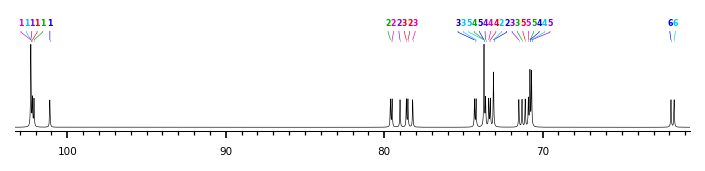
The spectrum also has 4 signals at unknown positions (not plotted). |
There is only one chemically distinct structure:
 report error
 Found 1 record.
Displayed record 1
Found 1 record.
Displayed record 1
