Taxonomic group: bacteria / Firmicutes
(Phylum: Firmicutes)
Associated disease: infection due to Bacillus subtilis [ICD11:
XM4SG9 
]
The structure was elucidated in this paperPublication DOI: 10.1134/S0026261712030125Journal NLM ID: 0376652Publisher: Moskva: Izdatelstvo Nauka
Correspondence: streshinskaya

mail.ru
Institutions: Zelinsky Institute of Organic Chemistry, Russian Academy of Sciences, Moscow, Russia, All-Russian Collection of Microorganisms (VKM), Skryabin Institute of Biochemistry and Physiology of Microorganisms, Russian Academy of Sciences, Pushchino, Russia, Faculty of Biology, Lomonosov Moscow State University, Moscow, Russia
The teichoic acids (TAs) of type strains, viz. Bacillus licheniformis VKM B-511T and Bacillus pumilus VKM B-508T, as well as phylogenetically close bacteria VKM B-424, VKM B-1554, and VKM B-711 previously assigned to Bacillus pumilus on the basis of morphological, physiological, and biochemical properties, were investigated. Three polymers were found in the cell wall of each of the 5 strains under study. Strains VKM B-508T, VKM B-424, and VKM B-1554 contained polymers of the same core: unsubstituted 1,3-poly(glycerol phosphate) (TA I) and 1,3-poly(glycerol phosphate) with O-D-Ala and N-acetyl-a-D-glucosamine substituents (TA II and TA III', respectively). The cell walls of two remaining strains contained TA I, TA II, and a poly(glycosylpolyol phosphate) with the following structure of repeating units: -6)-a-D-GlcpNAc(1-1)-snGro-(3-P-(TA III'') in 'Bacillus pumilus' VKM B-711 (100% 16S rRNA gene similarity with the type strain of Bacillus safensis) and -6)-a-D-Galp-(1-2)-snGro-(3-P-(TA III''') in Bacillus licheniformis VKM B-511T. The simultaneous presence of three different TAs in the cell walls was confirmed by the NMR spectroscopic DOSY methods. The structure of the polymers and localization of O-D-Ala residues were investigated by the chemical and NMR spectroscopic methods.
NMR spectroscopy, teichoic acid, Bacillus licheniformis, taxonomy, Bacillus pumilus
Structure type: polymer chemical repeating unit
Location inside paper: p.428, table 1, TA I, p.431, table 2
Trivial name: poly(glycosyl 1-phosphate)
Compound class: cell wall polysaccharide, teichoic acid
Methods: 13C NMR, 1H NMR, NMR-2D, 31P NMR, paper chromatography, composition analysis, genetic methods, paper electrophoresis
Biosynthesis and genetic data: phylogenetic position of the strains
Related record ID(s): 28637, 28638, 28639, 28640, 28641, 28642, 28643, 28644, 28645, 28646, 28647, 28648, 28649, 28650
NCBI Taxonomy refs (TaxIDs): 1402,
1408,
135461Reference(s) to other database(s): GTC:G09659CF
Show glycosyltransferases
NMR conditions: in D2O at 303 K
[as TSV]
13C NMR data:
Linkage	Residue	C1	C2	C3
0	x?Gro	67.8	70.9	67.8
	P


1H NMR data:
Linkage	Residue	H1	H2	H3
0	x?Gro	3.95-4.03	4.05	3.95-4.03
	P


1H/13C HSQC data:
Linkage	Residue	C1/H1	C2/H2	C3/H3
0	x?Gro	67.8/3.95-4.03	70.9/4.05	67.8/3.95-4.03
	P
1H NMR data:
| Linkage | Residue | H1 | H2 | H3 |
|---|
| 0 | x?Gro | 3.95
4.03 | 4.05 | 3.95
4.03 |
| | P | |
|
13C NMR data:
| Linkage | Residue | C1 | C2 | C3 |
|---|
| 0 | x?Gro | 67.8 | 70.9 | 67.8 |
| | P | |
|
There is only one chemically distinct structure:
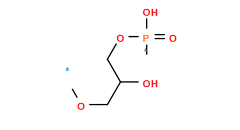 *OCC(O)COP(*)(=O)O
154.058 g/mol (C3H7R2O5P, R = next and previous repeats, not counted in mol weight)
 Found
Found  report error