Taxonomic group: bacteria / Fusobacteria
(Phylum: Fusobacteria)
Host organism: Homo sapiens
Associated disease: periodontitis [ICD11:
DA0C 
];
infection due to Fusobacterium nucleatum [ICD11:
XN4P8 ]
The structure was elucidated in this paperNCBI PubMed ID: 33280822Publication DOI: 10.1016/j.carres.2020.108198Journal NLM ID: 0043535Publisher: Elsevier
Correspondence: evguenii.vinogradov

nrc-cnrc.gc.ca
Institutions: Vaccine and Emerging Infections Research, Human Health Therapeutics Research Centre, National Research Council, Ottawa, ON, K1A 0R6, Canada
Fusobacterium nucleatum is a gram-negative bacterium, part of the normal human microflora. It is associated with various health complications, including periodontitis and colorectal cancer. Its surface is covered with lipopolysaccharide, which interacts with the immune system and can be involved in various processes in health and disease conditions. Here we present the results of structural analysis of core oligosaccharides from the lipopolysaccharides of several strains of F. nucleatum. Pure compounds were isolated using mild acid hydrolysis or alkaline deacylation of the lipopolysaccharides and analyzed by NMR spectroscopy, mass-spectrometry and chemical methods. All cores analyzed had a common octasaccharide region, including five heptose residues and a non-phosphorylated 3-deoxy-d-manno-oct-2-ulosonic acid residue. The common region is substituted with different additional components specific for each strain. By structure type the F. nucleatum core is similar to that produced by Aeromonas.
Lipopolysaccharide, NMR, structure, Fusobacterium nucleatum
Structure type: oligomer ; 1313.7
Location inside paper: table 1, Fig.1, table S8, Hep4anhHexd1Kdo1P2
Compound class: core oligosaccharide
Contained glycoepitopes: IEDB_130650
Methods: 13C NMR, 1H NMR, NMR-2D, 31P NMR, ESI-MS, mild acid hydrolysis, HPAEC, chemical methods, deamination, GPC, alkaline deacylation, fermentation
Comments, role: oligosaccharide was obtained by deamination of F. nucleatum strain 53G deacylated product; NMR temperature: 298 or 313.
Related record ID(s): 7582, 7583, 7584, 7585, 7586, 7587, 7589, 7590, 7591, 7592, 32207
NCBI Taxonomy refs (TaxIDs): 851
Show glycosyltransferases
NMR conditions: in D2O at 306 K
[as TSV]
13C NMR data:
Linkage	Residue	C1	C2	C3	C4	C5	C6	C7	C8
6,5,3,2	aXLLmanHepp	103.3	71.3	71.6	67.3	73.0	70.2	64.1-64.2
6,5,3	aXLLmanHepp	101.6	79.6	71.5	67.5	73.0	69.8	64.1-64.2
6,5,6	aXLLmanHepp	102.3	71.4	71.5	67.2	73.4	70.3	64.1-64.2
6,5,7	P
6,5	aXLLmanHepp	101.8	71.0	78.8	67.0	73.3	76.3	68.1
6	aXKdop	?	?	34.5	66.1	75.3	73.1	70.5	64.5
4	P
	x?Suga	61.8	84.6	77.5	82.0	82.6	64.6


1H NMR data:
Linkage	Residue	H1	H2	H3	H4	H5	H6	H7	H8
6,5,3,2	aXLLmanHepp	5.07	4.06	3.88	3.85	3.71	4.01	3.65-3.80
6,5,3	aXLLmanHepp	5.34	4.08	4.02	3.93	3.68	4.05	3.65-3.80
6,5,6	aXLLmanHepp	5.20	4.11	3.94	3.88	3.75	4.04	3.65-3.80
6,5,7	P
6,5	aXLLmanHepp	5.10	4.15	3.93	3.98	4.15	4.28	4.07-4.10
6	aXKdop	-	-	1.95-2.14	4.28	4.15	3.75	3.75	3.67-3.93
4	P
	x?Suga	3.69-3.74	4.02	4.23	4.42	4.21	3.56-3.63


1H/13C HSQC data:
Linkage	Residue	C1/H1	C2/H2	C3/H3	C4/H4	C5/H5	C6/H6	C7/H7	C8/H8
6,5,3,2	aXLLmanHepp	103.3/5.07	71.3/4.06	71.6/3.88	67.3/3.85	73.0/3.71	70.2/4.01	64.1-64.2/3.65-3.80
6,5,3	aXLLmanHepp	101.6/5.34	79.6/4.08	71.5/4.02	67.5/3.93	73.0/3.68	69.8/4.05	64.1-64.2/3.65-3.80
6,5,6	aXLLmanHepp	102.3/5.20	71.4/4.11	71.5/3.94	67.2/3.88	73.4/3.75	70.3/4.04	64.1-64.2/3.65-3.80
6,5,7	P
6,5	aXLLmanHepp	101.8/5.10	71.0/4.15	78.8/3.93	67.0/3.98	73.3/4.15	76.3/4.28	68.1/4.07-4.10
6	aXKdop			34.5/1.95-2.14	66.1/4.28	75.3/4.15	73.1/3.75	70.5/3.75	64.5/3.67-3.93
4	P
	x?Suga	61.8/3.69-3.74	84.6/4.02	77.5/4.23	82.0/4.42	82.6/4.21	64.6/3.56-3.63
1H NMR data:
| Linkage | Residue | H1 | H2 | H3 | H4 | H5 | H6 | H7 | H8 |
|---|
| 6,5,3,2 | aXLLmanHepp | 5.07 | 4.06 | 3.88 | 3.85 | 3.71 | 4.01 | 3.65
3.80 | |
| 6,5,3 | aXLLmanHepp | 5.34 | 4.08 | 4.02 | 3.93 | 3.68 | 4.05 | 3.65
3.80 | |
| 6,5,6 | aXLLmanHepp | 5.20 | 4.11 | 3.94 | 3.88 | 3.75 | 4.04 | 3.65
3.80 | |
| 6,5,7 | P | |
| 6,5 | aXLLmanHepp | 5.10 | 4.15 | 3.93 | 3.98 | 4.15 | 4.28 | 4.07
4.10 | |
| 6 | aXKdop |
|
| 1.95
2.14 | 4.28 | 4.15 | 3.75 | 3.75 | 3.67
3.93 |
| 4 | P | |
| | x?Suga | 3.69
3.74 | 4.02 | 4.23 | 4.42 | 4.21 | 3.56
3.63 | |
|
13C NMR data:
| Linkage | Residue | C1 | C2 | C3 | C4 | C5 | C6 | C7 | C8 |
|---|
| 6,5,3,2 | aXLLmanHepp | 103.3 | 71.3 | 71.6 | 67.3 | 73.0 | 70.2 | 64.1
64.2 | |
| 6,5,3 | aXLLmanHepp | 101.6 | 79.6 | 71.5 | 67.5 | 73.0 | 69.8 | 64.1
64.2 | |
| 6,5,6 | aXLLmanHepp | 102.3 | 71.4 | 71.5 | 67.2 | 73.4 | 70.3 | 64.1
64.2 | |
| 6,5,7 | P | |
| 6,5 | aXLLmanHepp | 101.8 | 71.0 | 78.8 | 67.0 | 73.3 | 76.3 | 68.1 | |
| 6 | aXKdop | ? | ? | 34.5 | 66.1 | 75.3 | 73.1 | 70.5 | 64.5 |
| 4 | P | |
| | x?Suga | 61.8 | 84.6 | 77.5 | 82.0 | 82.6 | 64.6 | |
|
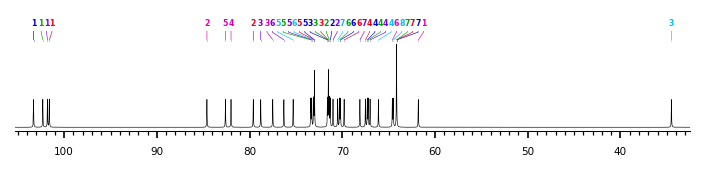
The spectrum also has 2 signals at unknown positions (not plotted). |
There is only one chemically distinct structure:
 report error
 Found 1 record.
Displayed record 1
Found 1 record.
Displayed record 1
