Taxonomic group: bacteria / Proteobacteria
(Phylum: Proteobacteria)
Associated disease: pneumonia [ICD11:
CA40 
];
nosocomial infections [ICD11:
XB25 ];
urinary tract infections (UTI) [ICD11:
GC08 ];
septicemia [ICD11:
MA15.Y ];
infection due to Klebsiella pneumoniae [ICD11:
XN741 ]
The structure was elucidated in this paperNCBI PubMed ID: 31606486Publication DOI: 10.1016/j.resmic.2019.10.001Journal NLM ID: 8907468Publisher: Elsevier
Correspondence: nikvol

obolensk.org; knirel
ioc.ac.ru
Institutions: N.D. Zelinsky Institute of Organic Chemistry, Russian Academy of Sciences, Moscow, Russia, State Research Center for Applied Microbiology and Biotechnology, 142279, Obolensk, Moscow Region, Russia
The Gram-negative opportunistic pathogen Klebsiella pneumoniae is a significant cause of community-acquired and healthcare-associated infections for which multidrug resistance is a concern worldwide. A major virulence determinant of K. pneumoniae is a polysaccharide capsule (CPS) which forms a barrier around the bacterial cell wall, providing protection from environmental pressures and immune responses of eukaryotic organisms. More than 70 chemical capsule structures of serologically typeable K. pneumoniae strains are known. However, there are little data on the CPS structure and cps gene cluster organization of clinical multidrug resistant K. pneumoniae strains. Our investigation of multidrug resistant carbapenemase OXA-48-producing K. pneumoniae strain KPB536 identified a capsular type that was structurally similar to K. pneumoniae K10 but different from any K. pneumoniae CPS reported so far. The content and organization of the cps gene cluster in K. pneumoniae KPB536 also was determined. The catalytic functions of glycosyltransferases coded by the cps_KPB536 gene cluster were assigned by comparison with those responsible for the synthesis of glycoside linkages in the CPSs of K. pneumoniae types K10 and K61.
capsular polysaccharide, glycosyltransferase, Klebsiella pneumoniae, multidrug resistance, Capsule biosynthesis genes
Structure type: polymer chemical repeating unit
Location inside paper: Fig.4, KPB536
Compound class: CPS
Contained glycoepitopes: IEDB_115136,IEDB_130701,IEDB_131186,IEDB_135818,IEDB_136044,IEDB_136906,IEDB_137472,IEDB_140630,IEDB_141794,IEDB_144983,IEDB_151528,IEDB_152206,IEDB_153201,IEDB_190606,IEDB_423153,IEDB_983930,SB_165,SB_166,SB_187,SB_195,SB_44,SB_67,SB_7,SB_72,SB_88
Methods: 13C NMR, 1H NMR, NMR-2D, DNA techniques, acid hydrolysis, GPC, bioinformatics analysis
Comments, role: minor repeating unit
Related record ID(s): 7641, 7642, 32227
NCBI Taxonomy refs (TaxIDs): 573Reference(s) to other database(s): GTC:G56313GW
Show glycosyltransferases
NMR conditions: in D2O at 333 K
[as TSV]
13C NMR data:
Linkage	Residue	C1	C2	C3	C4	C5	C6
2,6,3,2	bDGlcpA	103.0	74.1	77.4	78.1	77.3	?
2,6,3	aDManp	96.0	79.0	71.5	70.6	70.7	?
2,6	bDGalp	104.5	70.6	78.2	66.0	76.3	62.4
2	aDGalp	97.8	70.7	70.8	70.1	70.8	70.1
	aDGalp	97.2	74.1	69.1	70.6	71.5	61.9


1H NMR data:
Linkage	Residue	H1	H2	H3	H4	H5	H6
2,6,3,2	bDGlcpA	4.54	3.43	3.74	3.81	3.83	-
2,6,3	aDManp	5.15	4.15	3.93	3.76	4.00	?
2,6	bDGalp	4.47	3.63	3.76	4.16	3.67	3.78-3.80
2	aDGalp	5.21	3.90	3.93	4.07	4.34	3.87-4.06
	aDGalp	5.67	3.91	3.94	4.04	3.99	3.70-3.84


1H/13C HSQC data:
Linkage	Residue	C1/H1	C2/H2	C3/H3	C4/H4	C5/H5	C6/H6
2,6,3,2	bDGlcpA	103.0/4.54	74.1/3.43	77.4/3.74	78.1/3.81	77.3/3.83
2,6,3	aDManp	96.0/5.15	79.0/4.15	71.5/3.93	70.6/3.76	70.7/4.00	?/?
2,6	bDGalp	104.5/4.47	70.6/3.63	78.2/3.76	66.0/4.16	76.3/3.67	62.4/3.78-3.80
2	aDGalp	97.8/5.21	70.7/3.90	70.8/3.93	70.1/4.07	70.8/4.34	70.1/3.87-4.06
	aDGalp	97.2/5.67	74.1/3.91	69.1/3.94	70.6/4.04	71.5/3.99	61.9/3.70-3.84
1H NMR data:
| Linkage | Residue | H1 | H2 | H3 | H4 | H5 | H6 |
|---|
| 2,6,3,2 | bDGlcpA | 4.54 | 3.43 | 3.74 | 3.81 | 3.83 |
|
| 2,6,3 | aDManp | 5.15 | 4.15 | 3.93 | 3.76 | 4.00 | ? |
| 2,6 | bDGalp | 4.47 | 3.63 | 3.76 | 4.16 | 3.67 | 3.78
3.80 |
| 2 | aDGalp | 5.21 | 3.90 | 3.93 | 4.07 | 4.34 | 3.87
4.06 |
| | aDGalp | 5.67 | 3.91 | 3.94 | 4.04 | 3.99 | 3.70
3.84 |
|
13C NMR data:
| Linkage | Residue | C1 | C2 | C3 | C4 | C5 | C6 |
|---|
| 2,6,3,2 | bDGlcpA | 103.0 | 74.1 | 77.4 | 78.1 | 77.3 | ? |
| 2,6,3 | aDManp | 96.0 | 79.0 | 71.5 | 70.6 | 70.7 | ? |
| 2,6 | bDGalp | 104.5 | 70.6 | 78.2 | 66.0 | 76.3 | 62.4 |
| 2 | aDGalp | 97.8 | 70.7 | 70.8 | 70.1 | 70.8 | 70.1 |
| | aDGalp | 97.2 | 74.1 | 69.1 | 70.6 | 71.5 | 61.9 |
|
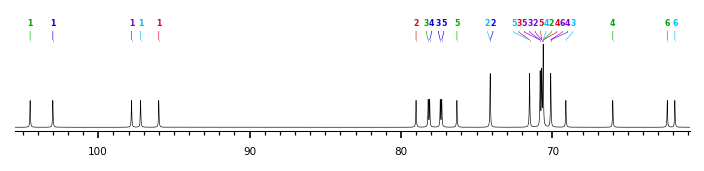
The spectrum also has 2 signals at unknown positions (not plotted). |
There is only one chemically distinct structure:
 report error
 Found 1 record.
Displayed record 1
Found 1 record.
Displayed record 1
