Taxonomic group: bacteria / Firmicutes
(Phylum: Firmicutes)
Associated disease: infection due to Clostridium perfringens [ICD11:
XN7J5 
]
The structure was elucidated in this paperNCBI PubMed ID: 32424044Publication DOI: 10.1074/jbc.RA119.009978Journal NLM ID: 2985121RPublisher: Baltimore, MD: American Society for Biochemistry and Molecular Biology
Correspondence: Christine M. Szymanski <cszymans

uga.edu>
Institutions: Department of Medical Microbiology and Immunology, University of Alberta, Edmonton, AB, Canada, Department of Biological Sciences, University of Alberta, Edmonton, AB, Canada, VaxAlta Inc., Edmonton, AB, Canada, Complex Carbohydrate Research Center, University of Georgia, Athens, Georgia, USA, Department of Laboratory Medicine and Pathology, University of Alberta, Edmonton, AB, Canada, Department of Biological Sciences, Virginia Tech, Blacksburg, Virginia, USA, Department of Molecular Microbiology, Washington University of Medicine, St. Louis, Missouri, USA
Clostridium perfringens is a leading cause of food-poisoning and causes avian necrotic enteritis, posing a significant problem to both the poultry industry and human health. No effective vaccine against C. perfringens is currently available. Using an antiserum screen of mutants generated from a C. perfringens transposon-mutant library, here we identified an immunoreactive antigen that was lost in a putative glycosyltransferase mutant, suggesting that this antigen is likely a glycoconjugate. Following injection of formalin-fixed whole cells of C. perfringens HN13 (a laboratory strain) and JGS4143 (chicken isolate) intramuscularly into chickens, the HN13-derived antiserum was cross-reactive in immunoblots with all tested 32 field isolates, whereas only 5 of 32 isolates were recognized by JGS4143-derived antiserum. The immunoreactive antigens from both HN13 and JGS4143 were isolated, and structural analysis by MALDI-TOF-MS, GC-MS, and 2D NMR revealed that both were atypical lipoteichoic acids (LTAs) with poly-(β1→4)-ManNAc backbones substituted with phosphoethanolamine. However, although the ManNAc residues in JGS4143 LTA were phosphoethanolamine-modified, a few of these residues were instead modified with phosphoglycerol in the HN13 LTA. The JGS4143 LTA also had a terminal ribose and ManNAc instead of ManN in the core region, suggesting that these differences may contribute to the broadly cross-reactive response elicited by HN13. In a passive-protection chicken experiment, oral challenge with C. perfringens JGS4143 lead to 22% survival, whereas co-gavage with JGS4143 and α-HN13 antiserum resulted in 89% survival. This serum also induced bacterial killing in opsonophagocytosis assays, suggesting that HN13 LTA is an attractive target for future vaccine-development studies.
glycoconjugate vaccines, NMR spectroscopy, gram-positive bacteria, Clostridium perfringens, cell surface, lipoteichoic acid (LTA), food safety, one health, necrotic enteritis, foodborne illness
Structure type: oligomer
Location inside paper: p.9518, Fig. 4B, table S2, fraction F2
Compound class: lipoteichoic acid
Contained glycoepitopes: IEDB_142488,IEDB_146664,IEDB_885813,IEDB_983931,SB_192
Methods: 13C NMR, 1H NMR, NMR-2D, GC-MS, SDS-PAGE, 31P NMR, deacylation, Western blotting, MALDI-TOF MS, composition analysis, serological methods, HF treatment, SEC, fluorescence microscopy, opsonophagocytosis assay
Comments, role: delipidated, dephosphorylated HN13 LTA polysaccharide.
Related record ID(s): 7645, 7646, 7647, 32231
NCBI Taxonomy refs (TaxIDs): 1502Reference(s) to other database(s): GTC:G55561BA
Show glycosyltransferases
NMR conditions: in D2O at 298 K
[as TSV]
13C NMR data:
Linkage	Residue	C1	C2	C3	C4	C5	C6
1,4,4,2	Ac	?	23.5
1,4,4	bDManpN	100.7	54.0	71.6	77.3	76.3	61.1
1,4,4,4,2	Ac	?	23.5
1,4,4,4	bDManpN	100.7	54.0	73.0	67.8	77.7	61.5
1,4	bDManpN	97.6	55.2	69.5	77.0	76.1	61.1
1	bDGlcp	103.5	74.1	74.9	79.1	75.6	61.1
	x?Gro	72.0	71.9	63.5


1H NMR data:
Linkage	Residue	H1	H2	H3	H4	H5	H6
1,4,4,2	Ac	-	2.06
1,4,4	bDManpN	4.84	4.57	3.93	3.73	3.49	3.76-3.88
1,4,4,4,2	Ac	-	2.06
1,4,4,4	bDManpN	4.85	4.61	3.82	3.51	3.43	3.80-3.92
1,4	bDManpN	5.03	3.91	4.11	3.79	3.56	3.76-3.89
1	bDGlcp	4.48	3.36	3.68	3.76	3.59	3.73-3.89
	x?Gro	3.76-3.92	3.93	3.60-3.67


1H/13C HSQC data:
Linkage	Residue	C1/H1	C2/H2	C3/H3	C4/H4	C5/H5	C6/H6
1,4,4,2	Ac		23.5/2.06
1,4,4	bDManpN	100.7/4.84	54.0/4.57	71.6/3.93	77.3/3.73	76.3/3.49	61.1/3.76-3.88
1,4,4,4,2	Ac		23.5/2.06
1,4,4,4	bDManpN	100.7/4.85	54.0/4.61	73.0/3.82	67.8/3.51	77.7/3.43	61.5/3.80-3.92
1,4	bDManpN	97.6/5.03	55.2/3.91	69.5/4.11	77.0/3.79	76.1/3.56	61.1/3.76-3.89
1	bDGlcp	103.5/4.48	74.1/3.36	74.9/3.68	79.1/3.76	75.6/3.59	61.1/3.73-3.89
	x?Gro	72.0/3.76-3.92	71.9/3.93	63.5/3.60-3.67
1H NMR data:
| Linkage | Residue | H1 | H2 | H3 | H4 | H5 | H6 |
|---|
| 1,4,4,2 | Ac |
| 2.06 | |
| 1,4,4 | bDManpN | 4.84 | 4.57 | 3.93 | 3.73 | 3.49 | 3.76
3.88 |
| 1,4,4,4,2 | Ac |
| 2.06 | |
| 1,4,4,4 | bDManpN | 4.85 | 4.61 | 3.82 | 3.51 | 3.43 | 3.80
3.92 |
| 1,4 | bDManpN | 5.03 | 3.91 | 4.11 | 3.79 | 3.56 | 3.76
3.89 |
| 1 | bDGlcp | 4.48 | 3.36 | 3.68 | 3.76 | 3.59 | 3.73
3.89 |
| | x?Gro | 3.76
3.92 | 3.93 | 3.60
3.67 | |
|
13C NMR data:
| Linkage | Residue | C1 | C2 | C3 | C4 | C5 | C6 |
|---|
| 1,4,4,2 | Ac | ? | 23.5 | |
| 1,4,4 | bDManpN | 100.7 | 54.0 | 71.6 | 77.3 | 76.3 | 61.1 |
| 1,4,4,4,2 | Ac | ? | 23.5 | |
| 1,4,4,4 | bDManpN | 100.7 | 54.0 | 73.0 | 67.8 | 77.7 | 61.5 |
| 1,4 | bDManpN | 97.6 | 55.2 | 69.5 | 77.0 | 76.1 | 61.1 |
| 1 | bDGlcp | 103.5 | 74.1 | 74.9 | 79.1 | 75.6 | 61.1 |
| | x?Gro | 72.0 | 71.9 | 63.5 | |
|
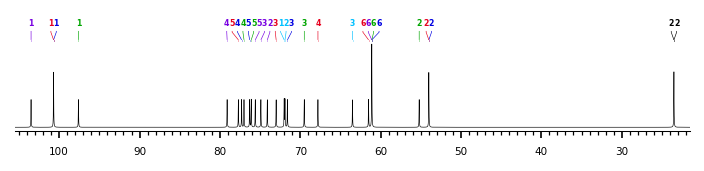
The spectrum also has 2 signals at unknown positions (not plotted). |
There is only one chemically distinct structure:
 report error
 Found 1 record.
Displayed record 1
Found 1 record.
Displayed record 1
